 |
| Cambridge Archaeological Unit/David Matzliach |
Cambridge Finds
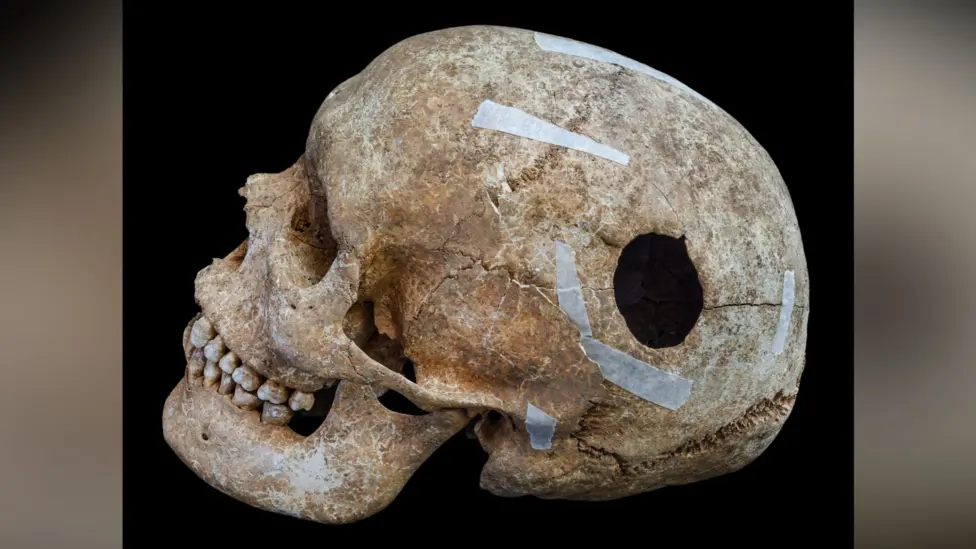
Recent excavations near Cambridge have uncovered a medieval execution burial. This was a mass grave, containing a number of individuals. The skull of one individual drew particular attention because it displayed a clear hole bored through it, and the signs of healing and bone remodelling showed that the individual had lived for some time after the procedure. Dr Trish Biers believed the individual may have undergone the procedure due in attempt to alleviate the symptoms of a pituitary gland tumour. This hypothesis is supported by the estimated height of 6ft 5ins (1.9m) – in a time when the average was around 5ft 6ins (1.65m). Osteometric analysis suggests the individual was between 17 and 24 years old at the time of his death. While many news sources have reported this as a ‘Viking skull’ – this is not certain at this stage – DNA and isotopic work will be carried out post-excavation to establish the heritage of the individual, and the other individuals who were buried in the same pit.
Procedure & Purpose
Trepanning – a process of a hole being drilled through the skull
– is one of the most widely found examples of medical intervention in the
archaeological record, and also one of the earliest. Indeed, evidence shows what may be considered
advanced skill in the process as far back as the neolithic era – showing that individuals
were well practiced in it. Indeed,
trepanning (also called trephination) is, historically, one of the most ‘successful’,
for a given definition of success, in the historical record.
Trepanning is often simplified as ‘drilling holes in the head
to let the evil spirits out’ – as one question to me put it – but the reasons
behind the procedure are not always that simple. While there certainly were cases where this
was the purpose, or the belief behind the procedure prior to the written record
its believed purpose is (more) reliant on interpretation and context. Intracranial pressure is also suggested.
Summary explanations can be found in White & Folkens The Human Bone
Manual and in Ortner, Identification of Pathological Conditions in Human
Skeletal Remains. An interesting article on the relationship between this
type of surgery & religion can be found here. It is important to note that the lines
between medicine and religion (and science and religion generally) have not
always been where they are today - and for the majority of human history have
been intertwined - from protective amulets and offerings to current debates on
medical ethics.
One notable aspect of trepanning is that the techniques
which were developed showed a high level of skill even in the earliest examples,
and it has been suggested that these developments might be considered the ancestors
of modern methods used in bone
marrow biopsies.